Greater Region

Miniature
Summary

The book essentially questions the way spaces can be described and empirically studied within or as cross-border relations. To do this, the author focuses on border dwellers in the Greater Region of SaarLorLux, insofar as its circular mobility structure and its presence in multiple neighbouring areas may be considered exemplary for cross-border life realities. The book hypothesises that spaces, rather than being pre-existing, allow for the development of subjectively significant spatial relations through cross-border activities. The concept of space therefore describes the significant social relations developed through border dweller practices, which are partially operationalised and studied empirically through socio-cultural questions.

Miniature
Summary

This study is an opportunity to analyse the consequences (for the citizen) of the setting up of space that is a genuine cross-border space as regards access to maternity care. It also underscores the importance of health cooperation in the Greater Region in order to avoid having areas of vulnerability. The examples studied in this regional space provide useful information for decision-makers in terms of territorial development. The analysis underscores the importance health cooperation based on collaboration at different levels: administrative, economic and technical, but also cultural in order to determine whether such an approach is feasible.

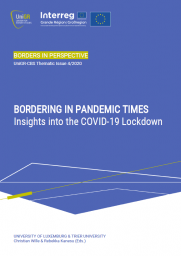
Borders in Perspective Vol. 4
Visuel
Borders in Perspective Vol. 4
Abstract

In the course of the COVID-19 pandemic, borders have become relevant (again) in political action and in people's everyday lives within a very short time. This was especially true for the inhabitants of border regions, whose cross-border life worlds were suddenly irritated by closed borders and police controls. However, the COVID-19 pandemic also led to an increased evidence of social, cultural, economic, health and mobility boundaries beyond national borders, which raised pressing questions about social inequalities. The authors shed light on these dynamics from the perspective of territorial borders, social boundaries and (dis)continuities in border regions through a variety of thematic and spatial approaches. The critical observations and scientific comments were made during the lockdown in April and May 2020 and provide insights into the events during the global pandemic. 


Miniature
Summary

The ESPON project “Metroborder” includes an investigation and the further development of the approach of a Cross-Border Polycentric Metropolitan Region (CBPMR) within the Greater Region and the Upper Rhine (Rhin Supérieur). The study refers to the “understanding of metropolises as nodes in a globalizing world” (p. 43). Aspects of the functional integration and governance structures in the case study regions are analyzed. Strategic options and specific approaches to the further development of CBPMRs are presented.

Miniature
Summary

In recent years, border work has become a major social, economic and human phenomenon in many countries. The authors of this chapter analyze the situation of border workers in Lorraine – a region which has seen a great increase in the number of border workers in the past – to ask, "how does the border impact on the different structural components of attitudes to employment and to border work (salary, social protection, mobility, qualifications etc.)?" (p. 125). After introducing the issue in question along with any methodological aspects implicated in conducting such an analysis, the authors describe how the flow of border workers has developed in the Greater Region. The main body of the chapter consists in analysis of the spatial, institutional, and socioeconomic dimensions of the employment relationship and border work.

Miniature
Summary

The articles in this edited collection deal with the conditions and obstacles of the cross-border flow of information. The question is also raised as to why the development of a European media public sphere has been a difficult undertaking. The investigations are mainly concerned with the Greater Region. It is clear that media production is still largely national in character. Above all, the concept of the “journalistic field” (Bourdieu) is used to contribute to an expanded understanding of European media phenomena.

Miniature
Summary

The Interregional Labour Market Observatory (IBA) is a network of specialized labor market institutes, all of which operate in the Greater Region. On behalf of the Summit of the Greater Region, the IBA collects data on labor markets in the Greater Region. This data is used to write reports on the labor market situation in the Greater Region. In addition to structural reporting based on comparable statistical data from the sub-regions of the Greater Region, the publication contains qualitative information on thematic focus areas.

Miniature
Summary

Included in an edited collection focusing on social services of general interest in Europe, this chapter considers the concept of "social service" as it is understood in France, and addresses concerns relating to spatial equality to diagnose issues of accessibility to maternity wards across the Greater Region. The representations provided differ from Anglo-Saxon approaches to measuring the territorial impact of social services of general interest, by taking a predominantly social approach. As the focus of the study, the Greater Region exemplifies the heterogeneity of issues of accessibility seen across neighboring regions.

Miniature
Summary

In the light of the Schengen Agreement border checks at the EU internal borders have largely been abolished. Thirty years after the signature of this agreement, Europe faces “refugee crisis” (EC 2016). After recent events such as the terrorist attacks in Paris and Brussels, some countries decided to re-establish border controls. What are the impacts of the reintroduction of these border controls from a spatial perspective? To answer this question, the authors propose a synthetic literature review on conceptual tools for analyzing the reintroduction of border controls and link these with a set of empirical findings. The focus is on the Greater Region, a cross-border region where functional flows are important.