Governance – Power – Cooperation

Miniature
Summary

Located in Belfast, Northern Ireland, the interdisciplinary Centre for International Border Research deals with border reconfiguration and conflict transformation at various levels. The academic staff involved comes from anthropology, geography, political science and sociology. The network represents an opportunity for scholars worldwide to network and exchange research outputs on borders. It does so by a wide range of activities: organization/supporting seminars and conferences, running a visiting fellowship programme, publishing working papers, hosting a well-documented multi-media resource platform. The website provides free access to a large extent of the network. The website documents mainly activities that ran in the 2000s and early 2010s.

Miniature
Summary

The borders are omnipresent within the greater region. The differences (in the areas of economics, social matters, tax matters, real estate, etc.) that they create are frequent reasons for mobility. Since an increase of moves from Luxembourg to the border regions (Saarland, Rhineland-Palatinate, Lorraine or Wallonia) has been observed recently, this work tries to determine the most important reasons and consequences of this phenomenon with its many facets.

Miniature
Summary

As part of a study on employment dynamics in the SaarLorLux Greater Region, this article analyses the employment and unemployment situation there and highlights the phenomenon of cross-border working that is rife there. As unemployment is high in certain areas in the region, exchanges have developed between countries in the form of cross-border working, which, although it creates jobs, raises complex issues on the taxation and social fronts.

Miniature
Summary

We, most of the time, look on border as simple artefacts on the ground serving a variety of practical reasons and that can be classified according to the purposes (political, social, economic, etc.) they serve and how they serve them. If they are necessary for all sorts of reasons, borders are also inherently problematic. Instead of adopting a rigid position about them, we need to consider them as movable structures that have advantages and disadvantages. Borders should define ‘dwelling’ rather than national spaces and motivate political responsibility for pursuit of a ‘decent life’ as not restricted to any particular state.

Miniature
Summary

The main goals of this work group are:
•    Highlighting issues, options, areas of responsibility, and specific activities of these regions;
•    Representation of their shared interest with the parliaments, legal entities, authorities and institutions on national and international levels;
•    Initiation, support and coordination of cooperation between the regions through Europe;
•    Encouragement to exchange experience and information to identify and coordinate the shared interests at the diverse issues and options, as well as to suggest potential solutions.
The work group of European border regions also does lobby work through the representation of the voice of the cross-border regions in the European institutes.

Working Paper Vol. 11
Visuel
UniGR-CBS Working Paper Vol. 11
Abstract

Analysing the database of the Luxmobil 2017 survey, this article presents the main outcomes concerning the spatial distributions of employment and modal choices related to commuting of both resident and cross-border workers within the Grand Duchy of Luxembourg. This analysis highlights the significant disparities regarding these distributions, the predominant car dependency and the required conditions to achieve a high modal share of public transport. Confronted with the challenging European objective of decarbonisation by the year 2050 and considering the national and supra-regional strategic documents, in order to coordinate urban development with the public transport offer, a voluntarist cross-border ‘transit-oriented development’ policy appears to be necessary. 
Policy Paper Vol. 2

Visuel
Policy Paper Vol. 2
Abstract

The policy paper 'Action Needs for Spatial Development in the Greater Region from a Research Perspective' summarises key findings of researchers from the UniGR-Center for Border Studies in five areas relevant to the Greater Region (demography and migration, transport, employment and economic development, energy land-scapes, cross-border governance) and formulates options for action for planning practice and political deci-sion-makers. In addition, it addresses the exchange of knowledge between research and politics.

Working Paper Vol. 10

Visuel
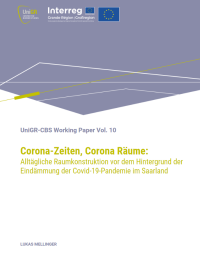
UniGR-CBS Working Paper Vol. 10
Abstract

As a reaction to the spread of the Covid-19 pandemic, many people all over the world were confronted with a rupture of social and spatial routines. In Germany, the state governments took a leading role trying to contain the further spread of the pandemic by issuing ordinances and regulations. In this context, the way how laws and rules pervade places of everyday life took on another (immediately perceptible) dimension for many people. This article aims at contributing a local perspective on this issue, focusing on the measures taken by the Saarland government. Through the qualitative method of autophotography, individual points of view on the underlying interactions of law, space and society are moved into the center of attention. Through the sociospatial perspective, the impacts of the measures taken by the local government are called into question.

UniGR-CBS Working Paper Vol. 9

Visuel
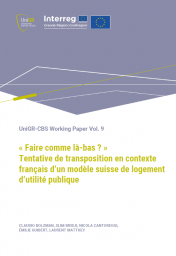
UniGR-CBS Working Paper Vol. 9
Abstract

Cross-border regions are often laboratories for the circulation of ideas and practices. This article asks whether, in Greater Geneva region, it is possible to transpose the cooperative housing model, fairly developed in Switzerland, into the French context, where this type of housing is less common. Using the example of Viry, a French municipality located within the institutional perimeter of Greater Geneva, the article analyzes the possibilities and limits of such a transposition. The results show the difficulty in emulating a context specific to reproducing the Swiss model of cooperatives in France. The legislative and institutional differences, but also cultural differences with regard to housing in its various dimensions are all obstacles to reproducing, identically in France, proven methods of construction of cooperative housing in Switzerland. It is therefore necessary to develop creative adaptations of different kinds so that the original model can find a place in the new context.

Working Paper Vol. 8

Visuel
UniGR-CBS Working Paper Vol. 8
Abstract

In current times, the coronavirus is spreading and taking its toll all over the world. Inspite of having developed into a global pandemic, COVID-19 is oftentimes met with local national(ist) reactions. Many states pursue isolationist politics by closing and enforcing borders and by focusing entirely on their own functioning in this moment of crisis. This nationalist/nationally-oriented rebordering politics goes hand in hand with what might be termed ‘linguistic rebordering,’ i.e. the attempts of constructing the disease as something foreign-grown and by apportioning the blame to ‘the other.’ This paper aims at laying bare the interconnectedness of these geopolitical and linguistic/discursive rebordering politics. It questions their efficacy and makes a plea for cross-border solidarity.