Interdisciplinary online lecture series: Border Realities
Border Realities: Borderlands and the Americas
The 2026/2027 edition of the online lecture series Border Realities explores the changing borderlands of the Americas in a time of geopolitical, social, and environmental transformation. From the U.S.-Mexico border and the U.S.-Canada border to Greenland and the Arctic, borders across the hemisphere are increasingly shaped by migration, Indigenous sovereignty, climate change, resource extraction, security regimes, and shifting global power relations.
Bringing together scholars from border studies, geography, political science, anthropology, Indigenous studies, and environmental humanities, the series examines how these developments reshape contemporary border realities and reconfigure borders as lived spaces, contact zones, and sites of contestation.
By focusing on borderlands across the Americas, the lecture series offers new perspectives on some of the most pressing challenges of our time while highlighting the enduring significance of borderlands as places of encounter, conflict, resilience, and possibility.
Themes include:
- Migration, mobility, and border governance at the U.S.-Mexico border
- Indigenous sovereignties and cross-border nations
- The U.S.-Canada border in changing geopolitical contexts
- Greenland, the Arctic, and emerging geopolitics
- Climate change and environmental transformations in border regions
- Resource extraction, energy transitions, and environmental justice
- Border security, surveillance, and militarization
- Water, rivers, and transboundary environmental governance
- Border cultures, identities, and communities
- Decolonial approaches to borders and border-making
- Cultural representations and border imaginaries
- Borderlands as spaces of resistance, resilience, and innovation
Dates will be available soon.
The UniGR-CBS lecture series “Border Realities” is open to the public and is aimed at researchers, students, and the interested public.
Contact
Denise Rodrigues
University of Luxembourg
denise.rodriguesmarafona@uni.lu
Acadamic chair
Astrid M. Fellner
Saarland University
UniGR-Center for Border Studies
Eva Nossem
Saarland University
UniGR-Center for Border Studies
Ben Hoy
University of Saskatchewan
Past lecture series
- Border Realities 2025/2026: Humanitarian Challenges at Borders
“Border Realities” is the UniGR-CBS's multidisciplinary, international, online lecture series. The 2025/26 edition explores the humanitarian challenges at borders.
National borders, which are often perceived as sites of control and reinforced security, are being reshaped by contemporary challenges and transformations. As well as their role in regulation, borders are also becoming places of humanitarian action, an issue that has recently been brought to the fore by current events.
The UniGR-CBS lecture series will examine the interaction between humanitarian practices and border regimes. It will address questions relating to the actors, contexts, practices and temporalities of humanitarian action at borders, as well as the role of languages and networks in shaping experiences of humanitarian work. International academic speakers will discuss issues such as:
- The meaning of humanitarian action at borders
- Humanitarian work in times of militarised borders
- Actors and practices of humanitarian action
- Temporalities and sites of humanitarian interventions
- Accounting for lives and deaths at borders
- Languages, networks, and humanitarian practices at borders
- 28/10/2025 | 4.00PM – Damien Simonneau (Institut national des langues et civilisations orientales)
Humanitarianism in times of border militarization
The answer to suffering and deaths at borderlands has been humanitarian interventions, based on international law and compassion for people on the move. Various humanitarian actors, citizens, IOs, and NGOs attempt to save lives at sea or on land. What happens when humanitarian reason is used to justify more control or to depoliticize these acts of solidarity, especially in areas shaped by heavy militarization? What happens when States unravel humanitarian actions and principles? This introduction to the lecture series will draw on classical debates and case studies surrounding the concept of “humanitarian borders”.
Damien Simonneau is an Associate professor in International Relations at INALCO in Paris, the French Institute dedicated to foreign languages and civilizations. His research interests lie in contemporary border security policy, encompassing its definition, public acceptance, implementation, and challenges, as well as international comparisons. After studying mobilizations around border fences in Israel and Arizona (USA), as well as the implementation of smart bordering during Brexit, his current research focuses on the history of border military engineering and its current global circulation.
- 02/12/2025 | 4.00PM – Antoine Pécoud (Université Sorbonne Paris Nord)
Protecting migrants or keeping them in their place? Migrant deaths, information campaigns and humanitarian dilemmas at the border
This presentation will discuss two types of political interventions that are characteristic of the humanitarian dilemmas raised by contemporary border control. The first is the prevention of migrant deaths, with a particular focus on the production of knowledge and statistics. The second is the organization of information campaigns to incite potential migrants to stay in their country. In both cases, the objective is to address the humanitarian challenges raised by deadly migration dynamics, but in a way that creates new patterns of violence.
Antoine Pécoud is professor of sociology at the University Sorbonne Paris Nord and member of the Institut Universitaire de France.
- 09/12/2025 | 4.00PM – Shoshana Fine (ESPOL - European School of Political and Social Sciences)
From “Humanitarian Interventions” to Migrant Deaths: The Legitimation of Violence through Law
This talk examines how liberal democracies legitimise violence through law. From “humanitarian” interventions to migrant deaths at sea, it shows how appeals to the universal, logical, and objective form of law make violence appear just, rational, and inevitable. Focusing on two cases, NATO’s so-called humanitarian intervention in Libya in 2011 and the deadliest Channel shipwreck in 2021, it explores how French political actors legitimised violence in both contexts through their appeal to law.
Shoshana Fine is Associate Professor of Political Science at ESPOL, the Catholic University of Lille, and a fellow of the Institut Convergences Migrations. Her research explores migration, political violence, and the politics of international law. Her forthcoming book, La violence au nom de la loi (co-authored with Thomas Lindemann), will be published by Presses de Sciences Po.
- 3/02/2026 | 4.00PM – Luna Vives (Université de Montréal)
The Gates of the Sea: Migration and Rescue at the Edges of Europe
Across the European Union, the politicization of sea migration has transformed maritime rescue systems into tools of border enforcement. Focusing on Spain’s maritime rescue agency (Salvamento Marítimo) and drawing on two decades of fieldwork, this research shows how humanitarian principles rooted in international law are being eroded by migration control policies. The presentation examines the foundations of maritime rescue, the history of Spain’s sea rescue agency, shifting migration routes in the Western Mediterranean and Atlantic, and rescue crews’ resistance—led by the CGT union—to becoming border guards, challenging Europe’s politics of organized abandonment.
Luna Vives is an Associate Professor in the Department of Geography at the Université de Montréal and the Director of the Centre Jean Monnet de Montreal. Her research explores how governments use borders to filter and exclude certain groups of people. Her work has been published in academic journals including Geopolitics, Political Geography, the Journal of Ethnic and Migration Studies, and the Journal of Borderland Studies. She contributes regularly to print media and radio.
The UniGR-CBS lecture series “Border Realities” is open to the public and is aimed at researchers, students, and the interested public.
Contact
Denise Rodrigues Marafona
University of Luxembourg
denise.rodriguesmarafona@uni.luAcadamic chair
Frédérique Morel-Doridat
Université de Lorraine
UniGR-Center for Border StudiesDamien Simonneau
Inalco – Institut national des langues et civilisations orientales
CESSMA – Centre d'études en sciences sociales sur les mondes africains, américains et asiatiques
- Border Realities 2024/2025: Border Realities: Beyond Nature and Culture
UniGR-CBS lecture series “Border Realities” 2024/2025:
Border Realities: Beyond Nature and Culture
October 2024-February 2025
Border Realities is the multidisciplinary, international and online lecture series of UniGR-CBS. The 2024/2025 edition of "Border Realities" is co-organized and chaired by Lola Aubry (UniGR-CBS, University of Luxembourg) and Anne-Laure Amilhat Szary (Pacte, CNRS, Université Grenoble Alpes) and explores border realities beyond the nature-culture binary.
Anthropogenic climate change and its consequences have eroded the Western paradigm of separating humans from Nature and Nature from Culture. In this context, it becomes imperative to reconsider the interdependencies between humans and the living world.
The lecture series will examine how the dissolution of the grand divide between nature and culture, alongside with questioning anthropocentrism in the humanities and social sciences, unveils new perspectives for studying borders and bordering as a natural-cultural phenomena. This will be approached from different disciplinary angles: geography, anthropology, political sciences, biology, and more. The International academic speakers will address issues such as:
- Natural borders and the naturalization of borders
- The roles of nonhumans in bordering processes
- Posthuman approaches to borders
- The connection and difference between biological and political borders
- Bordering and climate change
- Borders and Nature conservation
The lecture series “Border Realities” is open to the public and is aimed at researchers, students, and the interested public.
- 15/10/2024 | 4.00 PM – Timothy Raeymaekers (University of Bologna)
Reading the Mediterranean Border through Racial Capitalism
In this talk, Timothy Raeymaekers will present his monograph The Natural Border: Bounding Migrant Farmwork in the Black Mediterranean (Cornell 2024). Telling the recent history of Mediterranean agri-food capitalism from the perspective of marginalized Black African farm workers, the book argues that, in the context of global supply chains and repressive border regimes, agrarian production and reproduction are based on fundamental racial hierarchies.
- 26/11/2024 | 4.00pm – Juliet Fall (University of Geneva)
Along the Line: Writing about Nature, Borders and Infrastructure with Comics and Graphic narratives
This talk presents and discusses the upcoming book and comic Along the Line / Bornées (2024, MétisPresses, Genève) that diversifies approaches to territory, borders and security by infusing these concepts with feminist and critical perspectives to disrupt, unsettle, and re-write practices, discourses, and scholarly contexts. It provides an account of the world closer to the lived realities of messy, muddy, multiple and lively territories, open to the interplays between nature, borders and infrastructures.
- 18/12/2024 | 4.00pm – Marilou Sarrut (Institut de recherche pour le développement)
The Darien Jungle: A Natural Frontier as a Moral Alibi?
This presentation explores the Darien Jungle, often termed the "Tapon del Darien," as a pivotal site where geopolitical and humanitarian narratives intersect. Situated between Colombia and Panama, the jungle serves as a natural border traversed by over 500,000 migrants in 2023, seeking passage to the United States. Despite its portrayal in political and media discourses as a perilous "green hell," the Darien Jungle is increasingly utilized as a moral alibi to justify stringent immigration policies.
Registration here
- 15/01/2025 | 4.00pm – Mette N. Svendsen (University of Copenhagen)
Selective Fencing at Denmark’s Biological, Politico-geographical, and Genomic ‘borders’
This lecture tracks the regulation of the border crossings of pigs and people in and out of Denmark and makes an argument for investigating under one lens the biological, geographical, and genomic margins by which the nation defines itself.
Registration here
- 28/01/2025 | 4.00pm – Sylvain Guyot (University of Bordeaux Montaigne)
Eco-frontiers, or the very Nature of Borders of Nature (conservation)
What are the process that motivates humans to conquer a boundless, timeless and invaluable wilderness, in the name of plural ecologies to serve their own political interests in control and territory building? The ecological frontier (or eco-frontier), a neologism produced by a contemporary greened civil society, can be considered a new paradigm that embraces the mental representations and spatial constructions of eco-conquest without restricting its temporal dimension to the present time.
Registration here
- 12/02/2025 | 4.00pm – Xavier Oliveras-González (El Colegio de la Frontera Norte in Matamoros)
The Political Agency of Terrain in Bordering
In this lecture, I will defend a relational, post-humanist, and materialist conception of borders. I will understand them as a process co-constituted by the entanglement and interaction of multiple material entities, whether human or non-human, characterized by their unequal material properties and circulations. As I will demonstrate, at times, terrain contributes to bordering, and at others, it contributes to its resistance. To this end, I will refer to some examples from the Mexico-United States border.
Registration here
- 12/03/2025 | 4.00pm – Anne-Laure Amilhat Szary (Université Grenoble Alpes), Lola Aubry (University of Luxembourg)
The closing lecture of the UniGR-CBS lecture series “Border Realities: Beyond Nature and Culture” (2024/25) has been recorded. The organizers, Lola Aubry and Anne-Laure Amilhat Szary (University of Grenoble), reflect on the background of their research, link key contributions to their own research approaches, and offer an outlook on future projects.
Contact
Denise Rodrigues Marafona
University of Luxembourg
denise.rodriguesmarafona@uni.luAcadamic chairs
Lola Aubry
University of Luxembourg
UniGR-Center for Border StudiesAnne-Laure Amilhat Szary
Pacte, CNRS, Université Grenoble Alpes
- Border Realities 2023/2024: Crises, Resistances, Silences – Perspectives from the Border and Borderlanders
The 2023/2024 edition of the online lecture series “Border Realities” explores the concept and phenomenon of crisis from a border studies and borderlanders' perspectives.
Governments and international politics alike presume that during the past few decades, we have entered a global state of permanent crisis: a situation supposedly determined by troubled international relations, worldwide economic recessions, migration flows, health issues, climate change as well as warfare and other violent conflict. Such claims make for a need for research to engage with the concept and phenomenon of crisis, its political use, and its manifestations, especially from the perspectives of border studies.
The online lecture series will therefore bring together border scholars from geography, political sciences and anthropology to examine how the concept and phenomenon of crisis shape, intersect and complexify a multiplicity of border realities. The speakers will present various situated ways of being in and living-with crisis, offering a deeper understanding of this complex and often ambiguous phenomenon in the context of borders and borderlands. Borders and borderlands will be problematized as contexts, as locations, as systems where a plurality of crises materialize both silently and with force. The crisis of the borders themselves play a vital role in these processes.
By zooming in on crises of borders and in borderlands, the speakers thereby show how border realities can constitute a primary positionality to rethink and problematize the concept and phenomenon of crisis.
The online lecture series 2023/2024 is organised by the UniGR-Center for Border Studies (University of Luxembourg) and the Centre for Border Region Studies (University of Southern Denmark). The series “Border Realities” are open to the public and is aimed at researchers, students, and the interested public.
{"preview_thumbnail":"/sites/default/files/styles/video_embed_wysiwyg_preview/public/video_thumbnails/3Z9ejfWBt0Y.webp?itok=QDypL7O0","video_url":"https://www.youtube.com/watch?v=3Z9ejfWBt0Y","settings":{"responsive":0,"width":"570","height":"320","autoplay":0,"title_format":"@provider | @title","title_fallback":true},"settings_summary":["Embedded Video (570x320)."]}
11/10/2023 | 4.00 PM – Eeva Kaisa Prokkola & Satu Kivela (University of Oulu)
02/11/2023 | 4.00 PM – Rodrigo Bueno Lacy (University of Eastern Finland) & Henk van Houtum (Radboud University)
30/11/2023 | 4.00 PM – Astrid M. Fellner (Saarland University)
14/12/2023 | 4.00 PM – Georgie Wemyss (University of East London)
16/01/2024 | 4.00 PM – Anne-Laure Amilhat Szary (Université Grenoble Alpes)
08/02/2024 | 4.00 PM – Kolar Aparna (University of Helsinki), Dorte Jagetic Andersen (University of Southern Denmark), Lola Aubry (University of Luxembourg), & Manju Sharma
Contact
Denise Rodrigues Marafona
University of Luxembourg
denise.rodriguesmarafona@uni.luAcadamic chairs
Lola Aubry
University of Luxembourg
UniGR-Center for Border StudiesDorte Jagetic Andersen
Université du Danemark du Sud
Centre for Border Region Studies
- Border Realities 2022/2023: Transformation of the border and new conceptual challenges
For the past two decades, a resurgence of borders has been observed. On the one hand, this is shown by the remarkable increase in border controls, border walls and fortified border installations. On the other hand, however, it shows above all the progressive proliferation or multiplication of borders: they penetrate far into the spectrum of society, they manifest themselves very differently and figure spatially fragmented. This transformation of the border is no longer tangible with the familiar concept of the line, but is reflected in interconnected materialities, localizations, temporalities, corporealities, discourses, and multiple efficacies. These new forms of the border are not only challenging for political actors; also border scholars who engage with the changing border realities are confronted with new conceptual challenges.
The online lecture series starts from this point and aims to discuss the transformation of the border by means of empirical case studies as well as conceptual issues. International border researchers from the social sciences and cultural studies are invited to relate their own research and reflection results to the recent resurgence of borders and to elaborate on their new forms.
The online lecture series is open to the public and is aimed at researchers, students, and the interested public.
The public lecture series is organised by the UniGR-Center for Border Studies (University of Luxembourg) and the Centre for Regional and Borderlands Studies at the Institute of Sociology (University of Wrocław).
{"preview_thumbnail":"/sites/default/files/styles/video_embed_wysiwyg_preview/public/video_thumbnails/4g157FeFlS8.webp?itok=t4jE4PNt","video_url":"https://www.youtube.com/watch?v=4g157FeFlS8","settings":{"responsive":0,"width":"570","height":"320","autoplay":0,"title_format":"@provider | @title","title_fallback":true},"settings_summary":["Embedded Video (570x320)."]}
Contact and organisation
Denise Rodrigues Marafona (University of Luxembourg) info@borderrealities.org
Sylwia Zawadzka (University of Wrocław) sylwia.zawadzka@uwr.edu.plAcademic chairs
Christian Wille (University of Luxembourg)
UniGR-Center for Border Studies www.borderstudies.orgElżbieta Opiłowska (University of Wrocław)
Centre for Regional and Borderlands Studies www.obrop.uni.wroc.pl
- Border Realities 2021/2022: On the Renaissance of Borders in Uncertain Times
During the pandemic was the first time since the nation building that the borders of so many countries were closed at the same time. This event can be seen as the (preliminary) climax of a whole series of territorial (self-)securitizations, which call into question the idea of the “borderless world” that emerged in the 1990s. While territorial borders seemed to have lost their meaning under the influence of the expanding Internet, the fall of the Iron Curtain, increased mobility or global climate and environmental issues, a renaissance of borders has indeed been observed for the last two decades.
The resurgence of borders is mainly due to recent events, such as the sudden rise in terrorist attacks after the turn of the millennium, burgeoning nationalism, growing social inequalities and the ongoing migration management crisis in Western countries. They have not only brought about the accelerated digitization of the border regimes, the temporary reintroduction of border controls in the Schengen Area and the sealing off of the EU external borders, but have also led to increased uncertainty, social fragmentation and a multiplication of border infrastructures.
This development suggests that we have entered an age of borders both on a global scale and in the European border regions. Against this background, border studies in particular is called upon to provide appropriate knowledge regarding orientation and action. The multilingual lecture series builds on this and, on the one hand, brings together the multitude of topics and approaches of the multiparadigmatic field of work. On the other hand, it put research results up for discussion that result from the processing of current problems and challenges that bear the signature of the border. International researchers in spatial and cultural border studies are invited.
- 29/06/21 | 4.15pm – Daniela Johannes (West Chester University of Pennsylvania)
Dust and Death: Politics of Nature at the U.S.-Mexico Border
Moderation: Astrid M. Fellner (UniGR-CBS, Saarland University)More information here
- 29/09/21 | 4.30pm – Elżbieta Opiłowska (University of Wrocław)
Determinants of cross-border cooperation in the Polish–German borderland
The German-Polish borderland belongs to new border regions in Europe. It was created after WWII as a result of the Potsdam Treaty. However, for over 40 years the cross-border contacts were limited to meetings of communist officials and strongly controlled exchanges of activities. Thus, border communities could hardly develop any transborder interactions until the fall of communism.
During the lecture I will trace the development of the bilateral cooperation between Germany and Poland in the borderland and address the following questions: Which factors particularly enhance and which inhibit the cross-border cooperation? What role do the EU and state actors play in the Polish–German bilateral relations in border regions? The talk is based on the evaluation of expert interviews and both Polish and German documents that was carried out within the research project "Poland and Germany in the European Union - new forms and models of bilateral relations in foreign policy and cross-border cooperation" funded by the Polish-German Science Foundation.
Moderation: Christian Wille (UniGR-CBS, University of Luxembourg)More information available here
- 05/10/21 | 4.30pm – Jussi P. Laine (University of Eastern Finland)
Counter-Europeanisation as a Security Challenge: Rebordering borderlessness
The European Union’s project of consolidating political community and its own international actorness have encountered formidable obstacles - partly due to global shocks and partly due to internal crises. In this process, borders have come to play a critical role as an interface between domestic concerns and wider interstate and intercultural contexts. As markers of difference, their role as barriers to undesirable influences and threats perceived to emanate from the other side have only been reinforced. Under pressure, a number of governments have opted for the end-of-pipe solution of closing their borders in an attempt to restrict the incoming or transiting movement of people, some succumbing to the knee-jerk reaction to build walls and fences. We have witnessed a consistent drive for ever stricter border and migration policies, which are not limited to mere border management but become an inherent part of a wide range of polices and societal practices. Accordingly, the success of Europeanisation, understood as the emergence of common rules, values, social agendas, etc., is no longer self-evident.
Moderation: Christian Wille (UniGR-CBS, University of Luxembourg)
More information available here
- 12/10/21 | 8.00pm – Johan Schimanski (University of Oslo)
Temporalities and migratory border-crossings in literature and other discourse
Professor Schimanski presents the work he has been leading within the Joint Committee for Nordic research councils in the Humanities and Social Sciences workshop on temporalities and migratory border-crossings in literature and other discourse. He will also offer a more principled reflection on the working of borders and temporalities through the lens of border poetics.
Moderation: Machteld Venken & Christoph Brüll (UniGR-CBS, University of Luxembourg)
In cooperation with the UniGR-CBS working group Border Temporalities
- 10/11/21 | 4.30pm – Tracie Wilson (Martin Luther University Halle-Wittenberg)
Where Border Studies and More Than Human Worlds Meet
This talk explores the intersections of Border Studies with research that advances more than human, post-humanist, and new materialist perspectives. These approaches often expand concepts of agency, reject human exceptionalism, and stress the co-creative aspects of our experiences of “becoming with” non-human entities. Such orientations foster new ways to think about our connections to the natural world and can serve to validate affective and sensory experience. Yet, they also present certain challenges. Drawing on examples from my own research and the work of others, I consider the possibilities and limitations of these perspectives in addressing the making and un-making of borders and addressing matters of environmental justice.
Moderation: Antje Bruns (UniGR-CBS, Trier University)
- 17/11/21 | 4.30pm – Oleksiy Kiryukhin (V.N. Karazin Kharkiv National University)
Models of cross-border functional regions stability in the post-covid period for the purposes of territorial cohesion
- 18/11/21 | 2.00pm – Joanna Kurowska-Pysz (WSB University)
The cross-border functional area as a new solution supporting territorial cooperation in the European Union – a case study of the Polish-Lithuanian borderland
- 18/11/21 | 4.30pm – Hedwig Wagner (Europa-Universität Flensburg)
Les géo-médias à l'interface des sciences de géo- et des sciences des médias
Moderation : Grégory Hamez (UniGR-CBS, Université de Lorraine) and Angeliki Monnier (CREM)
- 06/12/21 | 4.30pm – Peter Ulrich (Brandenburgische Technische Universität Cottbus-Senftenberg)
Die Grenze im Zentrum. Bedingungen für gelingende grenzüberschreitende Zusammenarbeit im Europa der Grenzregionen in unsicheren Zeiten
In den letzten Jahren ist eine Renaissance der Grenze(n) in den europäischen Grenzregionen zu beobachten. Doch bereits zuvor war die Grenze auch im Schengenland präsent - allerdings im Hintergrund und eher unscheinbar. Die Grenze wurde im Zuge des europäischen Integrationspozesses ins Zentrum gerückt, um ein “Europa der Grenzregionen” zu befördern mit zahlreichen euroregional-institutionellen Kooperationen über EU-Grenzen hinweg. Die Grenze als multidimensionale und komplexe Entität wurde hier als Ressource und Bedingung für grenzüberschreitende Kooperation verstanden. Im Vortrag wird auf diese Korrelation von grenzbezogenen Faktoren und auf grenzüberschreitende Kooperations- und Governance-Prozesse eingegangen – aus einer vor-pandemischen Perspektive und in Zeiten der Corona-Krise.
Moderation: Christian Wille (UniGR-CBS, University of Luxembourg)
- 21/01/22 | 4.00pm – Damien Simonneau (Institut national des langues et civilisations orientales)
The digitization of border security
Migration and border controls are heavily digitized, generating ethical, organizational and political challenges. The guest lecture will first present the literature in security studies that addresses this data turn and focus on preliminary analyses on the digitization of the post-Brexit EU-UK maritime border.
Moderation: Karina Pallagst (UniGR-CBS, TU Kaiserslautern)
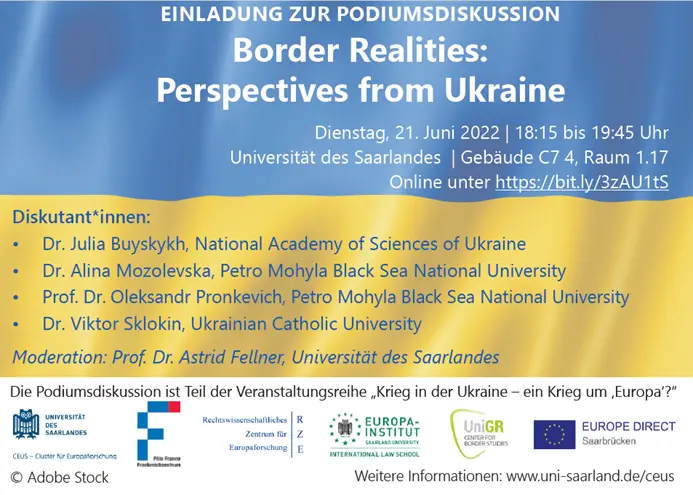
- 21/06/2022 | Border Realities: Perspectives from Ukraine (Saarland University)
In the series of conferences "The War in Ukraine - a war around 'Europe'" a round table discussion will take place on Tuesday, June 21, 2022 on the topic "Border Realities: Perspectives from Ukraine".
The discussants:
Dr. Julia Buyskykh, National Academy of Sciences of Ukraine
New-Old Boundaries in Anthropology: Ukraine as European “Other” Dr. Alina Mozolevska, Petro Mohyla Black Sea National University
Borders, Emotions and Counter-Propaganda: Analyzing Visual Discourse of Ukrainian Resistance Prof. Dr. Oleksandr Pronkevich, Petro Mohyla Black Sea National University
Maps, Borders and Ukrainian National Identity Dr. Viktor Sklokin, Ukrainian Catholic University
Concept of Borders in the Russian Imperial DiscourseMore information: here
The online lecture series is public and is aimed at researchers, students and interested practitioners within and outside of the Greater Region.Working Languages: German, French, English
Contact: Denise Rodrigues Marafona (denise.rodriguesmarafona@uni.lu)
Lecture Series of the Interdisciplinary Competence Center UniGR-Center for Border Studies
.
- Border Realities 2019/2020: Challenges and Perspectives in Uncertain Times
In times of COVID-19 pandemic, in the wake of the so-called "refugee crisis" and regimes of political regulations borders have moved more and more into focus. Through visible and invisible lines, they regulate the relationship between inside and outside, inclusion/exclusion and places of belonging.
These topics also play an important role for the regional-local context: especially in the Greater Region, cross-border living practices have turned into reality. In 2017, the Greater Region registered more than 230,000 cross-border workers. About 40,000 of them cross the border between Germany and Luxembourg every day.
The aim of this interdisciplinary lecture series (12/2019-12/2020) is to explore the scientific debate about physical and ideational borders spaces as to make (doctoral) students and experiences scholars of the Greater Region aware of borders and their challenges from a cultural, political and historical perspective.
Program and more information here
Organisers of the interregional lecture series
Anett Schmitz (University Trier)
Astrid Fellner (Saarland University)
Christian Wille (University of Luxembourg)Lecture series within the framework of the UniGR-Center for Border Studies and supported by the University of the Greater Region.
{"preview_thumbnail":"/sites/default/files/styles/video_embed_wysiwyg_preview/public/video_thumbnails/rgQ4OhD1kWA.webp?itok=dmuCZdFH","video_url":"https://www.youtube.com/watch?v=rgQ4OhD1kWA","settings":{"responsive":0,"width":"427","height":"240","autoplay":0,"title_format":"@provider | @title","title_fallback":true},"settings_summary":["Embedded Video (427x240)."]}
Virtual roundtable "Border realities in the Greater Region in times of the pandemic" (28/05/2020)
{"preview_thumbnail":"/sites/default/files/styles/video_embed_wysiwyg_preview/public/video_thumbnails/ukoqk70JllM.webp?itok=GyXhDaJd","video_url":"https://www.youtube.com/watch?v=ukoqk70JllM","settings":{"responsive":0,"width":"427","height":"240","autoplay":0,"title_format":"@provider | @title","title_fallback":true},"settings_summary":["Embedded Video (427x240)."]}
Guest Lecture "The Brexit and its limits: borderline realities, borderline fictions" (29/06/2020)
.